




It's 10:17 AM. You have spotted a perfect setup on Reliance—RSI just crossed above 30, volume is spiking, the 5-day MA crossed the 20-day. You reach for your mouse to place the trade.
By the time you have calculated your position size, double-checked the price, and clicked 'Buy,' it is 10:18 AM. The price has moved 0.9%. Your perfect entry? Gone.
This isn't a one-time thing. It's Tuesday. Again.
If you are still trading manually in 2025, you are not just working harder—you are fighting a losing battle against speed, emotions, and your own human limitations. Let's talk about what's actually costing you.
The Emotion Problem (And Why It's Worse Than You Think)
Here is something nobody wants to admit: you are your own worst enemy.
you are up ₹18,000 on a Nifty position. It is the best trade you have had this month. Then fear whispers, "What if it reverses?" You close it. Two hours later, you watch it climb another ₹35,000 from where you exited.
Or the flip side: you are down ₹7,000. Your stop-loss should trigger, but you override it. "It'll come back," you tell yourself. It doesn't. Now you are down ₹28,000, and that sick feeling in your stomach has replaced logic entirely.
This happens because trading triggers something primal. Fear, then greed, then hope… and finally panic. Your brain was not designed to handle financial risk rationally—it was designed to keep you alive on the savannah, not navigate derivatives markets.
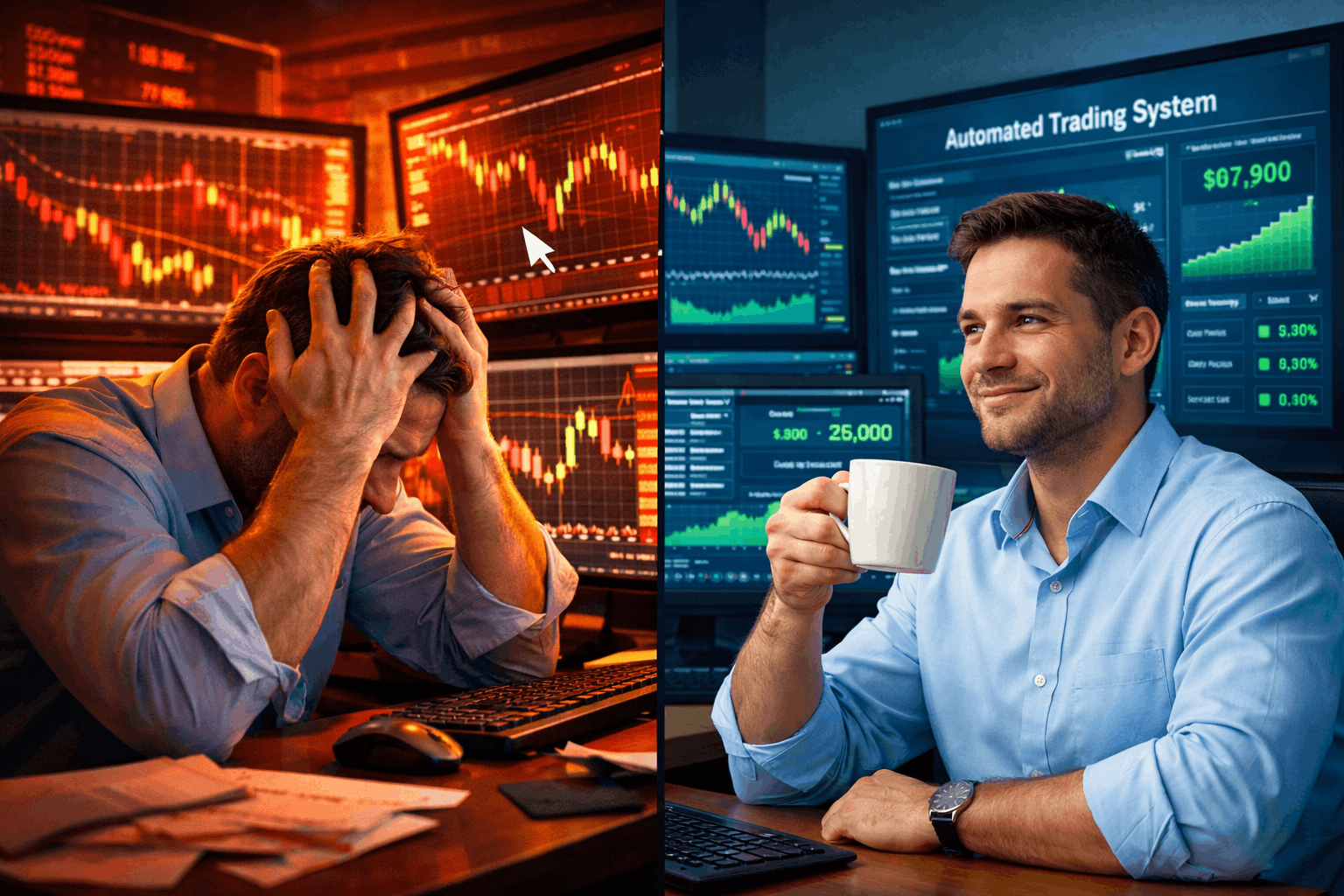
Automated systems don't feel anything. They execute the strategy you designed when you were calm and rational, not the strategy your panicked brain invents at 2:47 PM when you are down for the day.
Our exploration of Algo Trading Risks and How to Manage Them dives deeper into how removing emotional decision-making transforms consistency, but the core insight is simple: your feelings make terrible trading partners.
Speed, Monitoring, and the Limits of Human Attention
Let's be honest about what manual trading actually looks like.
You are watching Bank Nifty, tracking Reliance, keeping an eye on TCS, monitoring the VIX. Your strategy requires you to check six different indicators across multiple timeframes. You have got alerts set, but by the time you see the notification, analyse the setup, and place the order... the opportunity is gone.
Meanwhile, you missed a perfect setup on HDFC Bank because you were focused on that Reliance chart.
Humans cannot monitor multiple instruments simultaneously. We think we can, but we are actually just rapidly switching attention—and missing things in the gaps.
Automated systems don't have attention limits. They watch everything, all the time, and execute as soon as the conditions align. Not in two minutes. Not after you finish your coffee. Instantly.
The speed difference isn't just convenient—it's the difference between capturing opportunities and watching them slip away while you are still calculating position size.
The Consistency Gap Nobody Talks About
You have a strategy. You backtested it (or at least thought through it carefully). You know it works. But do you actually follow it?
After three losing trades, do you skip the next signal because you are "not feeling it"? After a big win, do you increase position size because you are on a roll? When the market gets choppy, do you start second-guessing your entry rules?
This isn't a discipline problem. It's a human problem.
Manual traders deviate from their plans constantly. Sometimes consciously, often unconsciously. Each deviation chips away at your strategy's edge until what you are actually trading bears little resemblance to what you tested.
Automation ensures you trade the strategy you designed, not some emotional variant that your brain invents when your money is on the line. Every signal gets executed exactly as planned. No exceptions. No "just this once."
For those wondering how to develop strategies worth automating in the first place, our guide on How to Know If Your Trading Strategy Is Actually Worth Automating provides a framework for evaluation.
The Backtesting Reality Check
Here is a question: how do you know your strategy actually works?
"It has worked for the past few weeks" is not an answer. That is hope, not data.
Proper backtesting means running your strategy across years of historical data, accounting for transaction costs, modelling realistic slippage, tracking dozens of performance metrics. Doing this manually for even one strategy would take weeks. Most traders never bother.
So they trade strategies that are not properly validated, hoping their limited manual testing represents reality. It usually does not.
Automated platforms include backtesting engines that can validate strategies across thousands of trades in minutes. You get actual data on win rates, maximum drawdown, Sharpe ratios, expectancy—the metrics that tell you whether your edge is real or imaginary.
Our detailed piece on Backtesting Fundamentals: The Power of Strategic Trading explores why this validation process matters so much, but here is the short version: if you have not backtested properly, you are guessing. And guessing with real money is expensive.
The Complexity Wall
Simple strategies are easy to execute manually. Moving average crossovers, basic support and resistance—you can handle that with a chart and a calculator.
But what about strategies that actually have edge in competitive markets?
Consider: Enter long when RSI crosses above 30 AND 5-EMA crosses 20-EMA AND volume exceeds 1.5x the 20-day average AND it's between 9:30-10:30 AM. Use dynamic stop-losses based on 2x ATR. Adjust position size based on current volatility and account equity. Set profit targets at 1.5x of your stop-loss distance.
Now run that across five instruments simultaneously.
Manually.
Without errors.
Yeah, that is not happening.
The strategies that actually work in modern markets tend to be complex—not complicated for the sake of complexity, but nuanced enough to handle different market conditions. Manual execution of these strategies ranges from impractical to impossible.
Automation handles complexity effortlessly. Whether your strategy has three conditions or thirty, it executes perfectly every time.
The Uncomfortable Truth About Competition
Here is what's actually happening in the markets you are trading:
Institutional players are running sophisticated automated systems. Professional trading firms have entire teams building algorithmic strategies. Even other retail traders are increasingly using automation.
And you are sitting there manually calculating position sizes and clicking buttons.
This is not 2010. The market has evolved. Speed matters. Consistency matters. The ability to execute complex strategies across multiple instruments matters. Manual traders are increasingly at a structural disadvantage.
You can be technically right about market direction and still lose to someone with an automated system that enters faster, exits more precisely, and never makes execution errors.
The playing field is not level anymore. The question is whether you will adapt or keep fighting with one hand tied behind your back.
So What Actually Changes With Automation?
Let's be clear about what automation does and doesn't do.
It doesn't guarantee profits. It doesn't eliminate the need for good strategy development. It doesn't mean you can set it and forget it.
What it does:
- Executes your strategy exactly as designed, every time
- Monitors markets faster and more completely than humans can
- Removes emotional decision-making from trade execution
- Validates strategies through proper backtesting before you risk real money
- Handles complexity that would be impractical manually
- Levels the playing field with institutional and professional traders
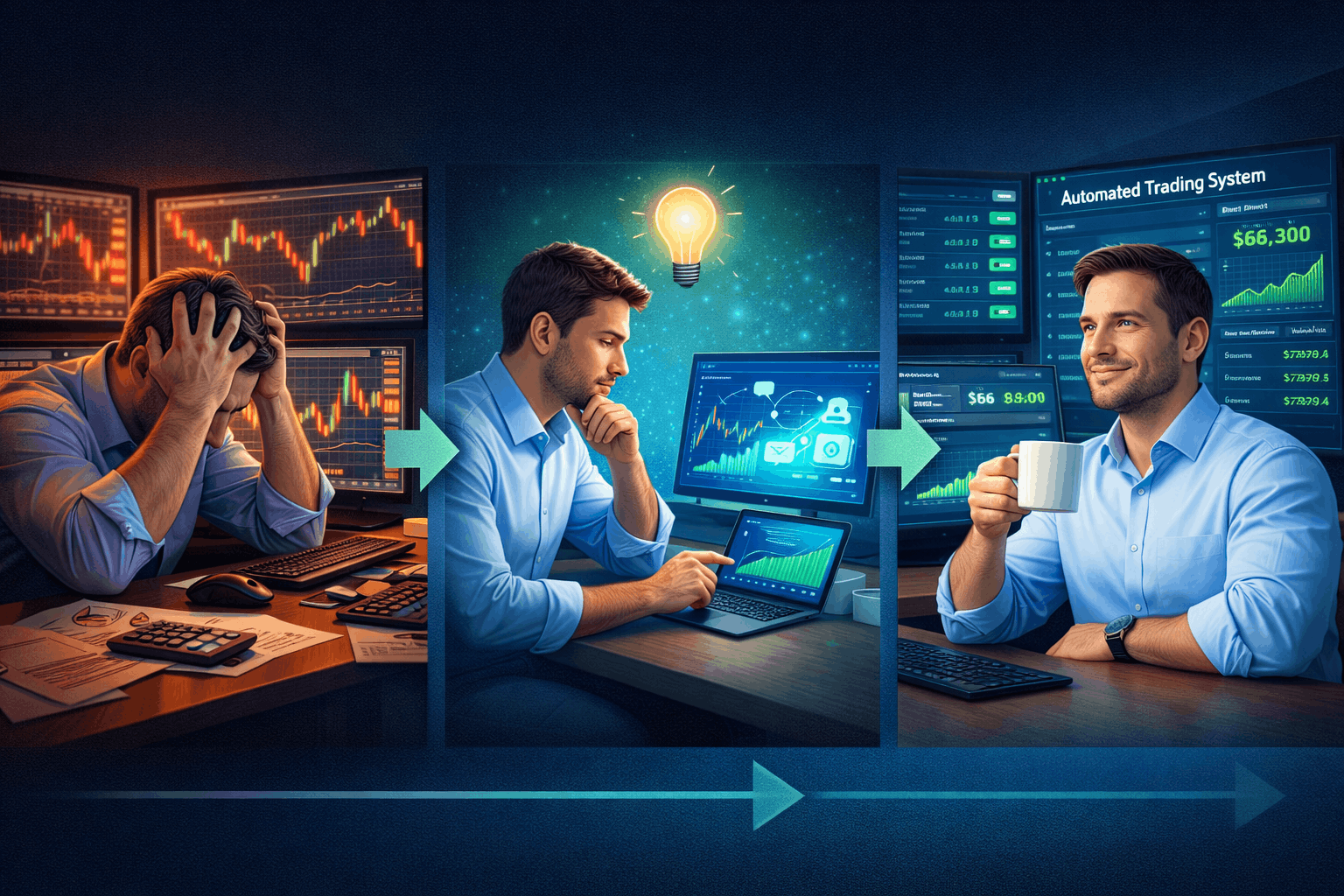
The difference isn't magic. It's mechanical. You are trading the same markets with the same strategies, but you are executing with the precision and consistency that actually allows edge to manifest over hundreds of trades.
For those just beginning to explore algorithmic trading, our guide on Algo Trading for Beginners: How to Start Algo Trading as a Retail Investor provides a practical roadmap from manual trading to automation.
The Real Question
You have been trading manually because that is what you know. That is what feels familiar. The idea of automating feels intimidating or unnecessary.
But ask yourself honestly: How many perfect setups have you missed because you were watching the wrong chart? How many times have you deviated from your plan because emotions took over? How much time do you spend staring at screens when an automated system could be monitoring for you?
The challenges of manual trading are not going away. Markets are getting faster, more competitive, more complex. The gap between manual and automated execution is widening, not shrinking.
The question isn't whether automation is better for executing systematic strategies. The data on that is pretty clear. The question is whether you will make the shift before the cost of staying manual gets too high.
Your strategy might be sound. Your market analysis might be excellent. But if you are executing manually in 2026, you are giving up edge to traders who are not.
That is not a criticism. It is just the reality of how markets have evolved.
The good news? The technology exists. The platforms are accessible. The only thing standing between you and systematic, disciplined, automated execution is the decision to make the change.
The uncomfortable truth is that manual trading isn't just harder anymore—it's increasingly becoming a competitive disadvantage you cannot afford.
Trading is hard enough without fighting your own psychology, human limitations, and execution errors. The question is whether you'll keep fighting those battles or let automation handle them whilst you focus on what actually matters: developing strategies with genuine edge.